Bluetooth · Missing Persons · Humanity

Be a Beacon.

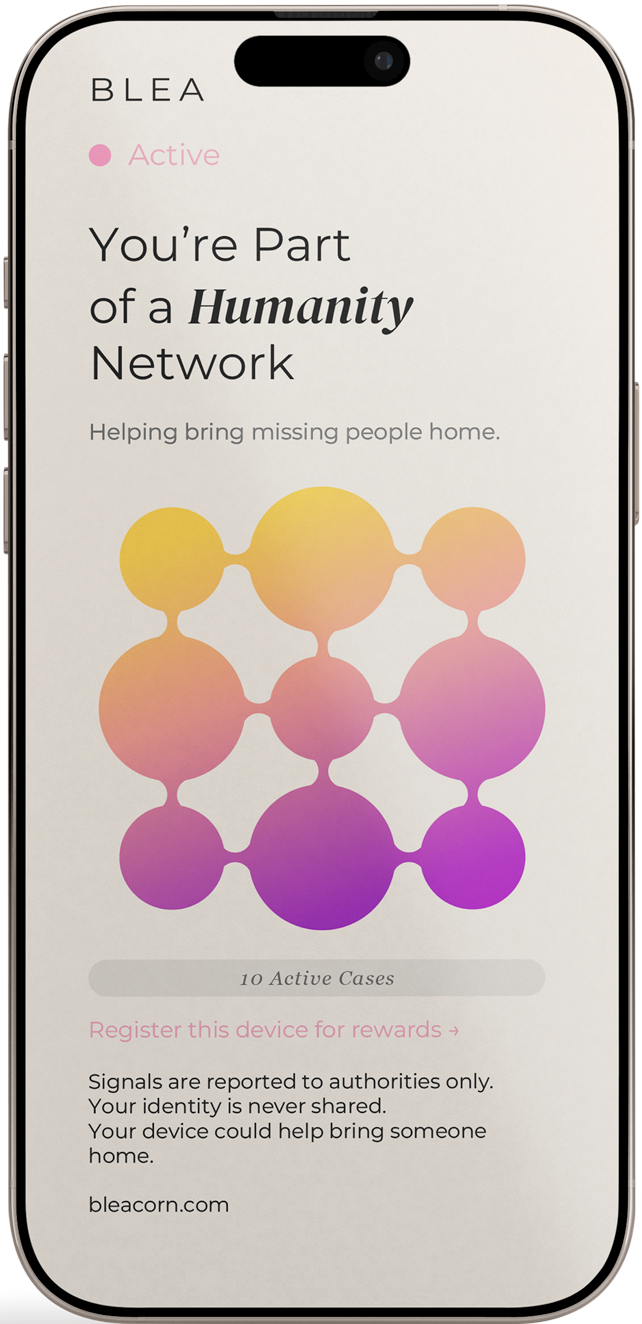
BLEACORN turns every smartphone into a silent search tool. When someone with a medical device goes missing, your phone helps find them — without you doing anything.

Signals Detected
Active Cases
3,000 +
Missing Persons with Pacemakers
24/7
Silent Scanning

Simple. Silent. Powerful.

01
Install & Forget
Download the app, grant Bluetooth and location permissions once. That's it. You never need to open it again.
02
Silent Scanning
BLEACORN quietly scans for BLE signals from Bluetooth-enabled medical devices — primarily pacemakers and neurostimulators — belonging to missing persons.
03
Signal Detected
If your phone passes within range of a target signal, BLEACORN captures the GPS coordinates and reports silently to authorities.
04
Someone Comes Home
Law enforcement sees the detection on a live map. Every person with the app is a node in a humanity network — covering ground no helicopter can.

What Happens When You Help.

You won't even know it happened. Your phone detects a signal, reports the location, and moves on. You go about your day.

If your detection leads to bringing someone home, the family may choose to share their posted reward with you. Just register your device in the app — name and phone — so we can reach you.


BLEACORN does not determine or guarantee rewards. Eligibility is decided by the posting family and applicable law.

"While helicopters search one spot,
millions of phones can search everywhere."

BLEACORN was inspired by watching search efforts for missing persons rely on expensive, limited resources — while millions of Bluetooth-enabled smartphones sat idle in people's pockets.

Modern pacemakers, glucose monitors, and other medical devices broadcast Bluetooth signals continuously — 24 hours a day, for up to 15 years. BLEACORN turns every phone into a passive detector for those signals, building a crowd-sourced search network that grows with every install.

This is not a commercial product. There are no ads, no subscriptions, no data sold. BLEACORN exists for one reason: to help families find their loved ones.

Activate the BLEACORN Network for a Missing Person

To submit a case, the missing person must have a Bluetooth-enabled medical device such as a pacemaker or neurostimulator. To uniquely identify the device, we need at least one of: the device's MAC address, Bluetooth name, or Service UUID. This information is available from the device manufacturer, the patient's monitoring app (e.g. Medtronic MyCareLink), or their cardiologist. A valid police report or FBI case number is required for verification.

Case verification requires a minimum donation of $250, which helps cover the cost of verification, server infrastructure, and keeping the app free for everyone. Additional donations are welcome.
Case submitted successfully.

Thank you for taking this step. We will verify your submission with the reporting agency and contact you at the email provided. This process may take 2–5 business days.

Once verified, the case will be added to the active BLEACORN monitoring network and distributed to all app users.

The Story Behind BLEACORN

In February 2026, the FBI mounted a signal sniffer1 on a helicopter and flew low and slow over Tucson, Arizona, trying to detect Nancy Guthrie's pacemaker. The technology worked in principle. The problem was coverage. A helicopter can only be in one place at a time, and a pacemaker's BLE signal only reaches a few dozen feet. Meanwhile, thousands of people were going about their day — driving to work, stopping for coffee, hiking, running errands — within range of wherever Nancy was. They just didn't know to listen. BLEACORN makes every one of those people part of the search, without asking them to do anything differently.

The insight is simple: modern medical devices — pacemakers, continuous glucose monitors, neurostimulators — broadcast Bluetooth Low Energy signals continuously, 24 hours a day, for up to 15 years. These signals are detectable by any standard smartphone within range.

BLEACORN builds a passive, crowd-sourced detection network from those phones. When someone with the app passes within range of a target signal, the GPS coordinates are silently reported to authorities. The person with the app doesn't need to do anything — just live their life.

The name comes from Bluetooth Low Energy + Acorn — the small thing that becomes something mighty. And it sounds like Beacon. Because that's what every phone with BLEACORN installed becomes: a beacon for humanity.

BLEACORN is a nonprofit initiative. There are no ads, no subscriptions, and no personal data is ever sold or shared. Detection reports contain only an anonymous identifier, GPS coordinates, and the matched signal — nothing that identifies the reporting phone's owner.

1 A signal sniffer is a portable radio detection device that scans for Bluetooth Low Energy (BLE) transmissions. In the Nancy Guthrie case (Tucson, AZ, 2026), the FBI mounted one on a helicopter to sweep for her pacemaker's signal. A pacemaker's native BLE range is roughly 10–15 feet — extendable to several hundred feet with amplifiers and high-gain antennas, but still limited by body tissue attenuation and physical terrain. Notably, the signal is weakest directly above and below the implant, and strongest at roughly the same horizontal plane — the exact range where a passing pedestrian, driver, or shopper would be.

For case submissions, use Submit a Case in the menu. For press inquiries or partnerships:
[email protected]

Privacy Policy

Last updated: March 2026

Terms of Use

Last updated: March 2026